The Passer By
A Story of Impermanence, Grace, and Letting Go

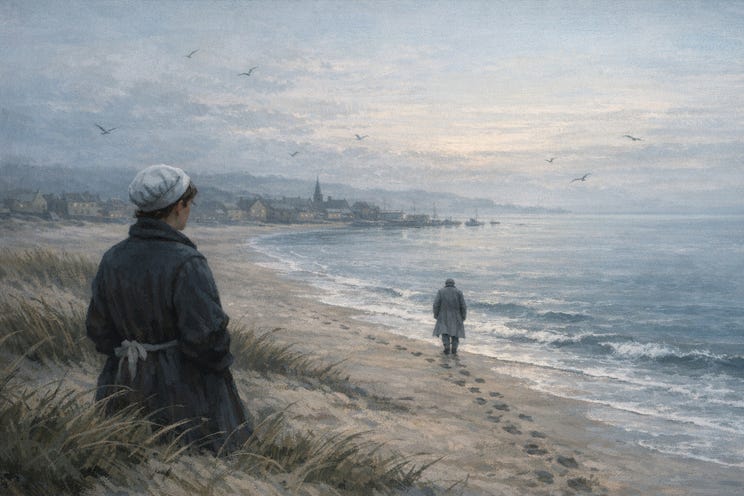
When the stranger first appeared in the town, no one noticed him arrive. This was partly because the rain had just stopped and everyone was preoccupied with their own reflections in the shop windows, with hats to shake dry and packages to rescue from the damp, and partly because he looked like the sort of man who belonged everywhere and nowhere at once. He wore a grey coat that seemed older than its cloth, carried no suitcase, and walked with the unhurried step of someone who had never confused distance with urgency. By evening, after he had crossed the square, paused by the fountain, and stood a long while watching the gulls turn above the harbour, people began to say they had seen him. But no two descriptions matched. Some thought him young, others old. Some remembered a face lined by grief, others a face as plain and open as water. He left that kind of uncertainty behind him, as if certainty itself could not fasten to his passing.
The first person to speak to him was Mara, who kept the bakery on Harbour Lane. She had flour on her wrists and a talent for measuring worth at a glance. She knew which fishermen would pay on time, which children stole currant buns for sport, and which visitors came wrapped in politeness but hid complaint under the tongue. When the stranger entered, she looked up prepared to sort him into one of her inner shelves. Instead, she found herself unable to place him. He asked for yesterday’s loaf, not todays, and thanked her as though she had done him a favour by letting him buy it. Then he stood aside to allow three impatient customers to pass, though he had no need to; there was room enough. Mara, who had spent years defending every inch of space and every crumb of effort, felt annoyed by his ease.
“You’re not from here,” she said, handing over the loaf. It was not a question.
“No,” he said. His voice was low, almost amused.
“Will you be staying?”
He broke the bread in half before answering, as if the loaf had to be shared with the room itself. “For a while,” he said.
“Everyone says that” Mara replied. “Then they either leave too soon or stay long enough to become somebody else.”
The man nodded, as if she had offered him a weather report.
“And what are you?” she asked, though she could not say why she was still talking to him.
He considered this with such seriousness that she nearly laughed. “Passing through,” he said at last.
“That’s not what I asked.”
“It is the truest answer I have.”
He rented a room above the potter’s workshop, paid a week in advance, and spent his days in ways that made the town restless. He helped where help was needed, but never so much that gratitude could turn into obligation. He carried coal for the widow Fenby, mended a gate for the schoolmaster, and once sat beside old Mr Penhall in the clinic waiting room without speaking for nearly an hour, which Mr Penhall later described as the finest conversation he had enjoyed in years. Yet the stranger refused all invitations to fix himself in place. He did not join the chapel committee, did not sign the petition about the road, did not tell stories about where he had been or where he meant to go. To questions, he offered attention instead of explanation. To praise, he bowed his head and let it fall away like rainwater from a brim.
This irritated Bernard Vasey more than anyone. Bernard was the town magistrate, a man who loved permanence with the hunger other people reserved for food or forgiveness. His office walls displayed certificates in polished frames; his desk held ledgers whose ruled lines comforted him like doctrine. He believed in names properly recorded, disputes neatly settled, boundaries respected, and the visible accumulation of good standing. The stranger’s existence was an affront to such order. A man should belong somewhere, Bernard thought, and if he did not, then he should at least declare what he wanted. Drifters brought trouble because they loosened the knots by which decent lives were tied together. More than once, Bernard watched the stranger cross the square and felt, absurdly, that the man’s very gait suggested an argument against property, rank, and effort.
The matter might have remained a private irritation if not for the storm in late October. It came fast from the east, hard enough to smash two boats against the quay and tear the roof slates from the post office. In the morning, the town moved through wreckage with that stunned vigour disaster produces, everyone acting at once, because to stop would be to feel. Mara found the stranger already at the harbour, ankle-deep in weed and splintered timber, helping a boy drag rope from the surf. Bernard was there too, issuing instructions. When a fisherman named Frank discovered that his boat, the Mercy Jane, had been driven half onto the shingle, a crowd gathered, because the Mercy Jane was his livelihood and because calamity, if sufficiently shaped, becomes spectacle.
The task was difficult but plain: the boat had to be lifted on the next swell and turned before the retreating water left it stranded broadside. Men shouted conflicting advice; children darted under elbows – Frank himself was white with fear. Then the stranger climbed onto a rock and spoke only three sentences, but each landed where it was needed. “Not all at once. Wait for the water. Lift where the weight wants to move.” Perhaps it was his calm, or the fact that his words made room for other people’s strength instead of competing with it, but the crowd obeyed. Mara braced her shoulder with the others. Bernard, to his credit, took hold of the bowline. On the third swell the Mercy Jane shuddered free. The harbour erupted in cheers loud enough to startle the gulls into flight.
Frank, weeping from relief, turned to seize the stranger’s hands and thank him before everyone. But the man had already stepped back. He was coiling a length of rope no one had asked him to coil, giving his attention to the wet fibres as if they deserved the same care as a rescued boat.
“It was all of us,” he said when Frank tried again.
“No,” Frank insisted, loud enough for the crowd, “you knew what to do.”
The stranger smiled, not proudly, not modestly, but in a way that made the distinction seem unimportant.
“The tide knew,” he said. “We only stopped fighting it.”
Many took this for cleverness. Bernard took it for evasion. Mara, though she did not yet know why, felt the words settle somewhere deeper than thought.
In the days that followed, the town made use of the story. At the bakery, customers retold it until the stranger’s few instructions grew ornate with each telling. The schoolboys imitated him atop barrels. Frank declared he would name his next boat after the man if only he could learn his name. This last detail caused fresh annoyance, because the stranger had never offered one.
“A person who will not name himself is hiding something,” Bernard said.
Mara was surprised to hear herself answer, “Or perhaps he’s tired of being what names require.”
The remark slipped out before she could recall it. She had never spoken against Bernard in public. Yet since the storm she had found herself thinking of all the things she gripped too hard: her accounts, her reputation for competence, the old sorrow she polished daily like a piece of family silver she could not bear to put away.
Mara had once been engaged to a sailor named Tomas, lost twelve years earlier when a winter squall overturned his vessel beyond Black Head. Since then, she had lived with an exacting fidelity to absence. She kept his letters in blue ribbon, his compass in the top drawer, his memory sharpened against forgetting until it could still cut her unexpectedly. People praised her devotion. It made a noble shape around her life. Yet she suspected, in sleepless moments, that what she preserved was not only love but also the identity grief had built for her: faithful Mara, stoic Mara, the woman who had suffered and therefore could not be asked to change. One dusk she found the stranger sitting on the sea wall, feeding crumbs to nothing, merely crumbling bread and letting the wind decide the rest. She sat beside him and said, “Do you never keep anything?”
He looked at the darkening water. “I keep what passes through me,” he said.
“That sounds like losing everything.”
“Only if you think holding is the same as having.”
She frowned. “That is exactly what having means.”
“For merchants, perhaps.” He smiled gently so she would know he was not mocking her trade.
“But tell me: the bread you bake – does it belong to you once it has fed someone?”
“I made it.”
“And then?”
She did not answer. He let the silence widen.
Finally, he said, “Some things are completed by leaving us. Music, for example. Breath. Kindness. Even sorrow, when we stop building a room for it and let it become weather again.”
Mara turned these words over like stones in her hand. They did not comfort her. Comfort would have been easier to refuse. Instead, they unsettled her in a way that felt almost like mercy.
Bernard, meanwhile, set about proving the stranger ordinary in the most disappointing sense of the word. He wrote to neighbouring towns, questioned carriers, and even checked the register at the inn in Merrow, where, according to one rumour, a similar man had slept two months before. The replies yielded almost nothing. Someone matching the description had mended a wall in one village, sat through a funeral in another, and once been seen giving away his coat to a beggar on the road to Whitcombe. No name attached itself securely to any of these sightings. Bernard grew more determined. To live without trace was, in his opinion, a form of insolence. Every decent person left records: debts, receipts, descendants, offences, or commendations. Without trace, how was character to be judged? Without judgment, what became of order?
He chose market day for the confrontation, perhaps because an audience lends weight to certainty. The square was full of carts and damp vegetables; hens objected noisily from wicker crates. Bernard stepped forward just as the stranger was helping an old woman tie her parcels with twine.
“Sir,” Bernard said, loud enough to gather attention, “before you continue accepting this town’s hospitality, perhaps you would tell us who you are, where you come from, and what business keeps you here?”
The square thinned into silence. Mara, behind her stall of brown loaves, felt her stomach tighten. The stranger finished the knot before replying.
“I have accepted bread, a bed, and conversation,” he said. “Hospitality deserves thanks. So, thank you.”
A few people laughed nervously. Bernard reddened. “That is not an answer.”
“It may be the only one that matters.”
“Names matter,” Bernard said. “History matters. A man should stand behind his deeds.”
“A deed stands or falls on its own,” the stranger replied. “If I lift a boat, is it less lifted because my papers are missing?”
“You’re twisting the argument.”
“No. Only a smaller claim.”
Bernard drew himself taller.
“You speak as though nothing should be possessed – no title, no station, no responsibility.”
“Responsibility, yes,” said the stranger. “Possession, less so. The more tightly we call things ours, the more frightened we become of their changing.”
Bernard gave a sharp, incredulous sound. “Easy words for a man with nothing to lose.”
At that, the stranger’s face altered, not with anger but with a depth of weariness so brief it might have been mistaken for shadow.
“On the contrary,” he said softly. “They are learned only by losing.”
The market held its breath. Bernard opened his mouth, then closed it, because there are moments when argument senses a wound and finds itself suddenly ashamed.
After that, Bernard did not apologise, but his pursuit cooled into observation. The town, having come close to cruelty and recoiled from its own reflection, resumed ordinary life with excessive kindness toward the stranger, as communities do when they wish to forget themselves. It was from Widow Fenby that Mara later learned the nearest thing to his history. He had once had a wife and a daughter in a city inland; fever had taken one, a factory fire the other. Whether this was true Widow Fenby could not say, only that the information had come from a traveller who heard it from a priest who claimed to have buried a child under the same surname the stranger sometimes used. Mara found that the uncertainty mattered less than it once would have. Grief, she was beginning to understand, did not confer ownership over pain. Suffering too moved like weather, visiting one roof after another.
Winter drew in. Frost feathered the inside corners of windows, and the sea took on that iron colour which makes even daylight seem stern. Mara began, without announcing it to herself, to change. One morning she untied Tomas’s letters and read them as if they had been written to a younger woman she still loved but no longer needed to imitate. Another day she gave his compass to a cabin boy whose own father had gone missing off the northern shoals. The gesture hurt. Then the hurt passed through her and left behind not emptiness, as she had feared, but room. She found herself laughing more readily. She stopped correcting people when they misremembered old events. At the bakery she no longer counted each bun sold as if every coin had to defend her against fate. Things came; things went. The ovens still needed tending, but the fire itself taught her: flame lives by consuming, not by keeping.
One pale morning near the end of February, Mara saw the stranger standing outside the potter’s workshop with the same grey coat, brushed clean, and the same empty hands with which he had arrived. There is a way the body knows departure before the mind allows it; she felt it at once.
“You’re leaving,” she said.
He nodded.
“For a while?” she asked, hearing their first conversation return like a tide to the same stone.
He smiled. “Something like that.”
She wanted, suddenly and absurdly, to demand a promise: that he would come back in spring, that he would at least tell her where he meant to go, that he would let himself be held in memory by more than a blurred anecdote. Instead, she asked, “Why go when people care for you here?”
He looked toward the harbour, where gulls lifted and settled on the morning wind.
“Because care is best when it is not turned into a cage,” he said.
She walked with him as far as the dunes beyond Black Head. The path was wet with thaw, and their footprints darkened the sand behind them. At the crest they stopped. The sea below was quiet, breathing in long glassy lines. Mara felt that old instinct to preserve the moment – to speak some sentence worthy of ending, to ask a final question that would pin meaning in place like a moth under glass. But the stranger had taught her, not by instruction so much as by manner, that life withers under too much pinning.
So she only said, “Thank you for passing through.”
He bowed, as if the phrase itself were a blessing returned. Then he began to walk along the shore, neither quickly nor slowly, until distance softened him into a shape among other shapes: a man, a post, a drift of shadow, then only movement.
Mara remained on the dune until the tide began its patient erasure. One by one the footprints filled, blurred, and disappeared, not tragically, not unjustly, but as part of the great courtesy by which the world makes room for what comes next. She thought of Bernard in his office, of Frank’s rescued boat, of Tomas’s letters, of the stranger’s nameless losses, of bread broken and given away, of storms that wrecked and storms that freed. For the first time in many years, she did not feel diminished by transience. She felt instructed by it. To be a passer-by, she understood now, was not to love the world less. It was to love it without trying to own its passing forms; to serve without engraving one’s name into the service; to suffer without building a throne from sorrow; to meet each hour fully and let it go whole. Below her, the sea kept no record and forgot nothing. Mara turned back toward town, toward ovens to light and customers to greet, carrying no relic except a wider heart.